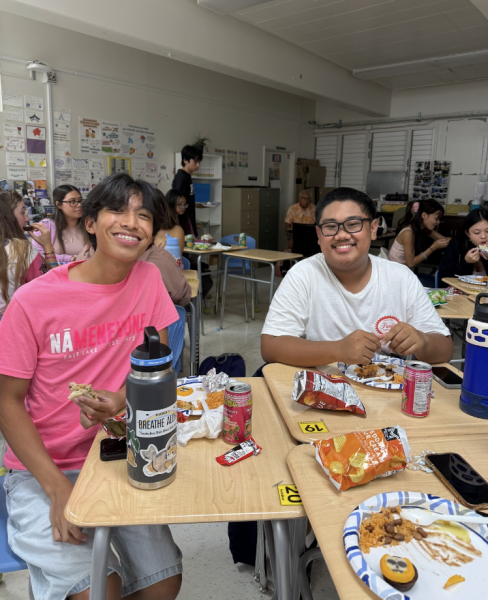
Moanalua High School’s Spanish Club hosted a party on Oct. 29 to kick off their club and to learn about the Mexican tradition, Día de los Muertos. During the party, club members watched parts of movies depicting people visiting their family members’ resting places and leaving offerings. Including the Movie “the Book of Life”.They played games where they translated what was happening in images. Food was provided by Alejandro’s Mexican Food, a long time supporter of their program. The club members enjoyed their time learning and sharing their knowledge of the holiday and traditions. Moanalua’s Spanish classes made marigolds out of colorful paper and mini Piñatas.
This 3,000-year-old Mesoamerican holiday dates back to the Aztec Empire, located in modern day central Mexico. The Aztecs had a cyclical, meaning circular or reoccurring, view of life, where death was a central part. They believed that when a person passed, they traveled to “Chicunamictlán”, which is known as the Land of the Dead. Then they travel for several years completing nine challenges.
These challenges included crossing the Great River (Apanohuayan), avoiding getting crushed by the crashing mountains (Tepeme Monamictlan), climbing the mountain covered in obsidian knives and facing the obsidian-bladed wind (Iztehecayan), enduring a storm of arrows (Timiminaloayan), having your heart eaten by wild beasts (Teocoyohuehualoyan), swimming through a violent black ocean that washes away earthly sorrows (Izmictlan Apochcalolca), and finally, traveling through dense fog to reflect on, and entirely forget your life’s choices. (Chicunamictlan).
If you completed these challenges, you would reach your final resting place in Mictlan. Here, under the watch of Mictlantecuhtil and his wife, Mictecacihuatl, you would stay. To the Aztecs, these challenges weren’t punishment. Rather, they were a purification process. They would be cleansed of all their hardships, and their pure soul would remain. Often, rituals were held in August, where they left food, water, and tools to aid their journey, which inspired modern ofrendas.
When the Spanish came to Mesoamérica, they brought Catholicism with them. Before the rise of Catholicism, Pagan celebrations of the dead heavily influenced the Catholic holidays of All Soul’s Day and All Saint’s Day, celebrated on Nov. 1 and 2, respectively. The Spanish would bring wine and pan de ánimas, also known as spirit bread, inspiring modern Día de los Muertos traditions.
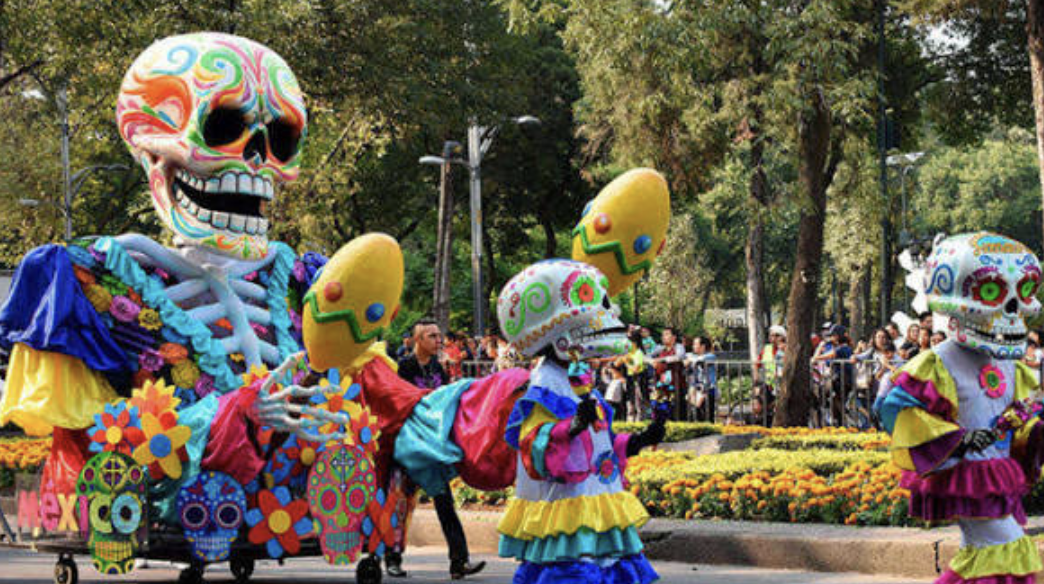
Modern traditions for Día de los Muertos include making ofrendas, which are memorials for your family where you leave offerings. As offerings, people often leave the favorite foods of the deceased and Pan de Muerto, which is bread of the dead. People also decorate with marigolds, which are associated with the sun, and are believed to guide spirits back home. The biggest Día de Los Muertos celebration is the Mexico City parade held on Nov. 1 and 2. People in elaborate costumes and floats dance and parade through the streets. Artists set up public displays of Alebrijes, which are statues of spirit animals carved from wood and painted in vibrant colors. People from all over the world come to appreciate the vibrant holiday from Mexico!