

In early 2025, the Hawaii Department of Education (HIDOE) surveyed every school principal on their campus’s policy regarding cell phone usage. Out of the 257 schools, 85.6% (220) of schools had a current phone usage policy in place. This year, in early February, the HIDOE announced a new cell phone policy for all public schools that would begin with the 2026-27 school year. For elementary and middle schools, phone use will be entirely banned until after school hours. For high school and intermediate schools, the rules will be a little different. “Cell phone use is prohibited during instructional time. Schools may exercise discretion regarding use outside of instructional time, including before and after school, and during designated breaks, recess, lunch, and free periods,” states the HIDOE.
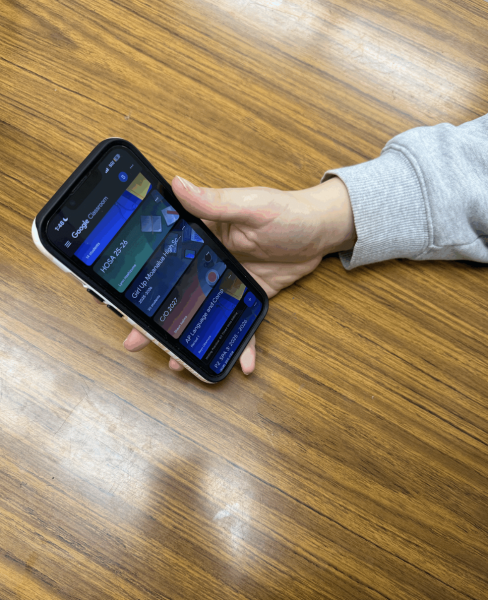
This can bring some big changes to Moanalua High School. Many students and teachers find themselves using cell phones as valuable resources, not just as a distraction. Computer and iPad carts aren’t accessible to most classrooms, so for long writing assignments or research papers, most teachers are left with two options: borrowing library computers or using cell phones. Sometimes, the phones are simply a quicker and more accessible way to allow students to complete homework or knock out assignments.
Many teachers rely on the phones as a quick alternative to going to the library, or requesting laptops in advance. Phones make it easy for students to access the internet, and save sources and actually gain experience in researching.
“It was a big change coming from middle school. We had access to Chromebooks, now I rely solely on my phone. On paper, there’s only so much research you can do; books aren’t as accessible as the Internet can be,” shared an anonymous student when asked about her experiences using her phone for research.
“In my history class, I find myself needing my phone for assignments. I think my phone is essential for [Google] Classroom and [Google] Slides. Even though it would cost a lot of money, bringing laptops back would be beneficial. Students will have restrictions on school devices and not be so sidetracked,” states freshman Kendall Miller on her experience with cell phones at school.
“Personally, I didn’t mind the current phone policy. Many of my teachers use our phones for educational purposes,” says another anonymous sophomore.
Many students at Moanalua High School weren’t even aware of the policy change. “I didn’t even know the phone policy was changing, I feel like it hasn’t been advertised,” shared a freshman student.
A student with a similar viewpoint explains, “It doesn’t feel good when I’m not aware of change, it feels like I have no say. What if I walked in next year unaware of the change in policy?”
“I had heard about it, I didn’t actually know if it was real or not,” stated one unaware sophomore student.
Some students share concerns regarding social interactions and how phones affect teen communication. “I think having no phones will force more connections, it’s discouraging to look around a classroom and see everyone on their phone and not talking to each other.” One student shared a differing opinion, “I don’t think my phone restricts me from my social time; I don’t need my phone.”
One 10th grade student shares her advice for policymakers. “Don’t restrict teen interaction. Some students prefer to text other friends, or if you’re busy it’s sometimes easier to quickly text than have a whole conversation.”
The real question is, how could this new statewide change affect you as a Moanalua High School student? Well, expect a rise in paper assignments, as well as a more frequent usage of computer carts or iPads. Be sure to utilize resources in the library, such as desktop computers, laptops, and even the printers (start saving your coins). And if you like to work with background noise, maybe get used to not playing music while working. Remember, putting your phone down isn’t permanent– you can always look forward to using it when class is over!


