On Friday, March 27, 2026, the World Language Festival was held at Moanalua High School. With each language hosting a booth in the cafeteria, the event promoted the learning of different languages and the exposure of diverse cultures through various interactive activities. Located in the top right of the cafeteria’s stage were Chinese classes 1 and 2. The tables hosted for the Chinese language areas had two games: mahjong and Chinese chess.
Mahjong is a matching game consisting of about 144 tiles, where you draw and discard tiles in order to win with 14 matching tiles. Zhuolin Deng (9), a volunteer helping at the Chinese booths, helps explain how the game is played. “Basically, what it is is like a traditional Chinese game that’s played by the older generation. It’s really about getting pairs and trying to complete a set in order to win. You need four or more players, depending on how you want to play,” Deng says. A winning hand for mahjong requires four sets of three of a specific kind of tile (referred to as ‘pung’ in-game) or a set of three consecutive tiles (referred to as ‘chow’ in-game) and one pair of tiles.
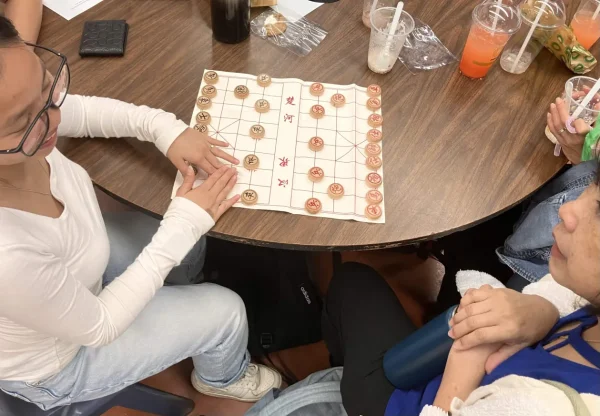
Zhuolin Deng teaches a booth attendee how to play Chinese chess.
Chinese chess, or “xiangqi”, is very similar to the original game of chess, as the name implies. The difference, however, aside from the rules, lies in how the board is set and how you play against your opponent.
“Over here is Chinese chess. It’s not even chess; it’s the Chinese way to play it. The objective is the same as normal chess. You’re still trying to eat the king, it’s just that the pieces move differently. One of our finals was to set up the chessboard, “ mentioned Deng.
Its unique set of rules differs from what is expected in western chess. Some examples include the following: stalemates are considered wins, generals can never face each other directly, and a player cannot be checked for more than three times with the same piece from their opponent. Rules such as these leave less room for error than western chess would.
Learning opportunities not only lie in how to play, but also in how to speak whilst playing. Learning a language is necessary when it comes to being able to win. Mei Yee Cheng, teacher and advisor of the Chinese class and club, respectively, explains how these activities help learn the language. “So for both [mahjong and Chinese chess], they have to be able to understand the characters of the chess pieces and the mahjong tiles. They learn basic terms on what to say and how to make a certain move, such as ‘check’, ‘I win’, ‘ four in a row’. It’s a fun way to learn language,” said Cheng.
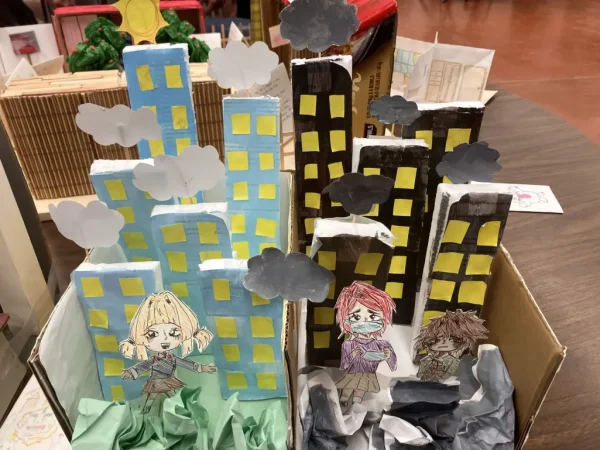
Presentation by Tiffany He and Kelly Zhang.
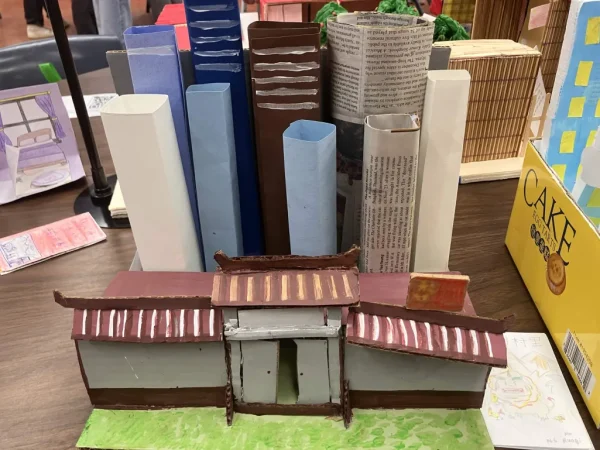
Presentation by Shiwen Feng.
One way to overcome the language barrier is to present through art. In the same section of the cafeteria were students who created art projects to shed light on issues that arise in China, such as the modernization and erosion of Chinese traditions and the pollution that affects poor areas.
“The various displays were projects that [the students] did in class, where they had to do some research by reading articles or research on their own so that they could talk about their project in Chinese,” said Ms. Cheng.
Across all cultures, an experience that many can relate to is the need for connection and community to one another. Games as these excel in being both an interactive and enjoyable way to learn about Chinese culture. As such, whatever you may speak, art is the language that breaks barriers.